

Finlay Millar | Senior Strategist | 12 November 2026
Travel productions are meticulously planned for breadth. A week-long shoot can produce hundreds of clips and photographs, enough material to cover the various experiences that make somewhere worth visiting. Yet far too often these large-scale productions end in six published pieces.
The rest goes into an archive. Months later the next shoot goes ahead and nobody opens it. The same pieces of content that could have told several different stories, or the same story in several different ways, are discarded after one post. The Reel that got 10 times more views than the channel average is chalked up as a massive win and something to strive for with future content, rather than an opportunity in content that already exists.
This is a publishing problem. Travel brands invest in content that could influence travelers across months, platforms and stages of a decision, then treat its value as spent after one appearance.
Why content rarely gets a second outing
There are multiple reasons for this practice, and it often starts with the shape of production. A lot of travel brands still work to one or two large shoots a year. Everything is captured in two weeks, and that material then has to be rationed across 12 months.
A content calendar built a year out is the default way to manage it. Campaigns, seasonal moments and events take the slots before anything has been shot, before anyone knows what the footage looks like or what performed. Anything reactive means displacing something already in place.
Brands shooting continuously have the opposite problem, and it’s a better one. More material arrives than the calendar can absorb. The question stops being how to stretch two weeks’ footage across a year and starts being what purpose each piece serves. When a trend lands, or the data moves, or travelers start asking something new, there is already something to reach for rather than a brief and a wait.
The second cause is how performance gets measured. Teams report on posts published, impressions generated and engagement achieved. Once a piece has been reported, the incentive is to move on. Nobody is asked what else the original investment could have delivered. Publishing becomes the finish line instead of the first stage of an asset’s life.
The calculation travel brands are getting wrong
Another key reason is a misunderstanding of what algorithmic reach means for a travel brand.
Instagram’s Adam Mosseri has been clear about it. Repost an identical Reel and it will probably get less reach, and people who have already seen it are less likely to engage. An unchanged upload risks not being treated as original content at all.
None of that is wrong. But taken in isolation, it misses what travel brands are actually trying to achieve on social.
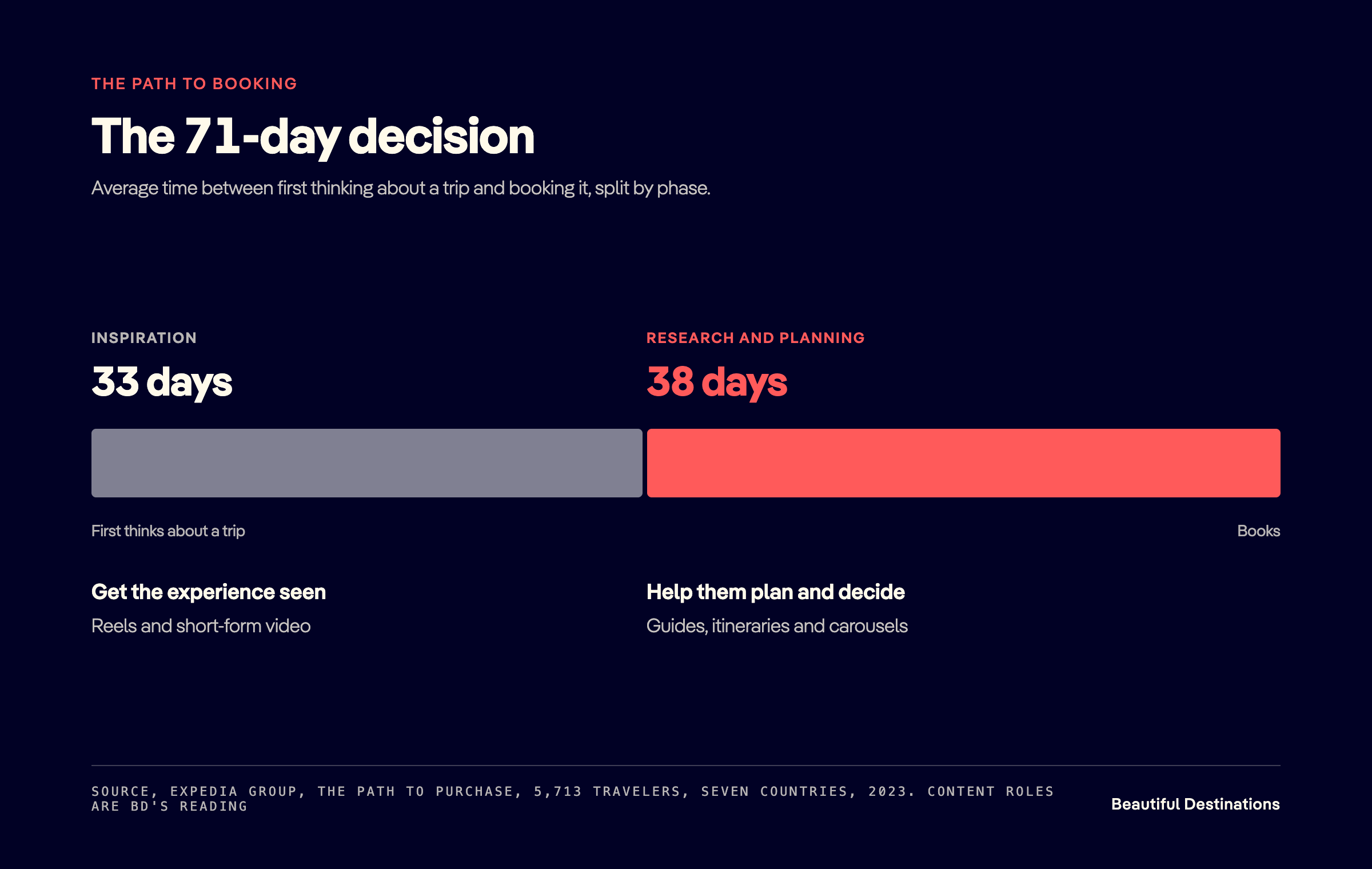
Mosseri is advising creators trying to maximize reach. Travel brands are working on something harder, a decision that unfolds over weeks and multiple touchpoints. Expedia puts the average time between first thinking about a trip and booking it at 71 days, with 33 spent on inspiration and 38 on research and planning. McKinsey and Skift Research found that 74% of travelers revisit the same websites or apps several times before deciding.
Give the same content a different job
A piece that performs well is telling you what to make next. Often the answer is already in the footage, and recutting or reformatting a high-performing asset gives travelers something that feels new while keeping the details they responded to the first time.
Recutting keeps the same footage and changes what it leads with. Say a montage of a coastal town performs well, and a lot of the comments mention the seafood market that appears for a couple of seconds near the end. Recut the same clips so the market comes first and it becomes a different hook for a different traveler. Nothing new has been filmed, but the opening has changed and so has the reason to keep watching.
Reformatting moves what worked into a format that does a different job. If a beautiful shot showcasing one experience lands as a video, build an itinerary around that hook. If a guide or itinerary video lands, turn it into a carousel that reaches people the video never did. BD’s channel data shows why the format matters. Reels drive a 2.5x higher share rate and 35% more engagement than static posts, while saves on carousels are up 28% year on year, a sign of deeper planning intent. Reels and other short-form video are designed to get experiences in front of people, whereas guides and carousels, made once it is clear what people are interested in, help pull them further down the funnel.
If something performs extremely well, the simplest option is still open, and it’s the one brands dismiss too quickly. Recutting will almost always do better, but posting the same piece again months later still beats leaving it in the archive. If a piece performs 10 times better than a typical post and the repeat does half as well, that is still five times the typical post.
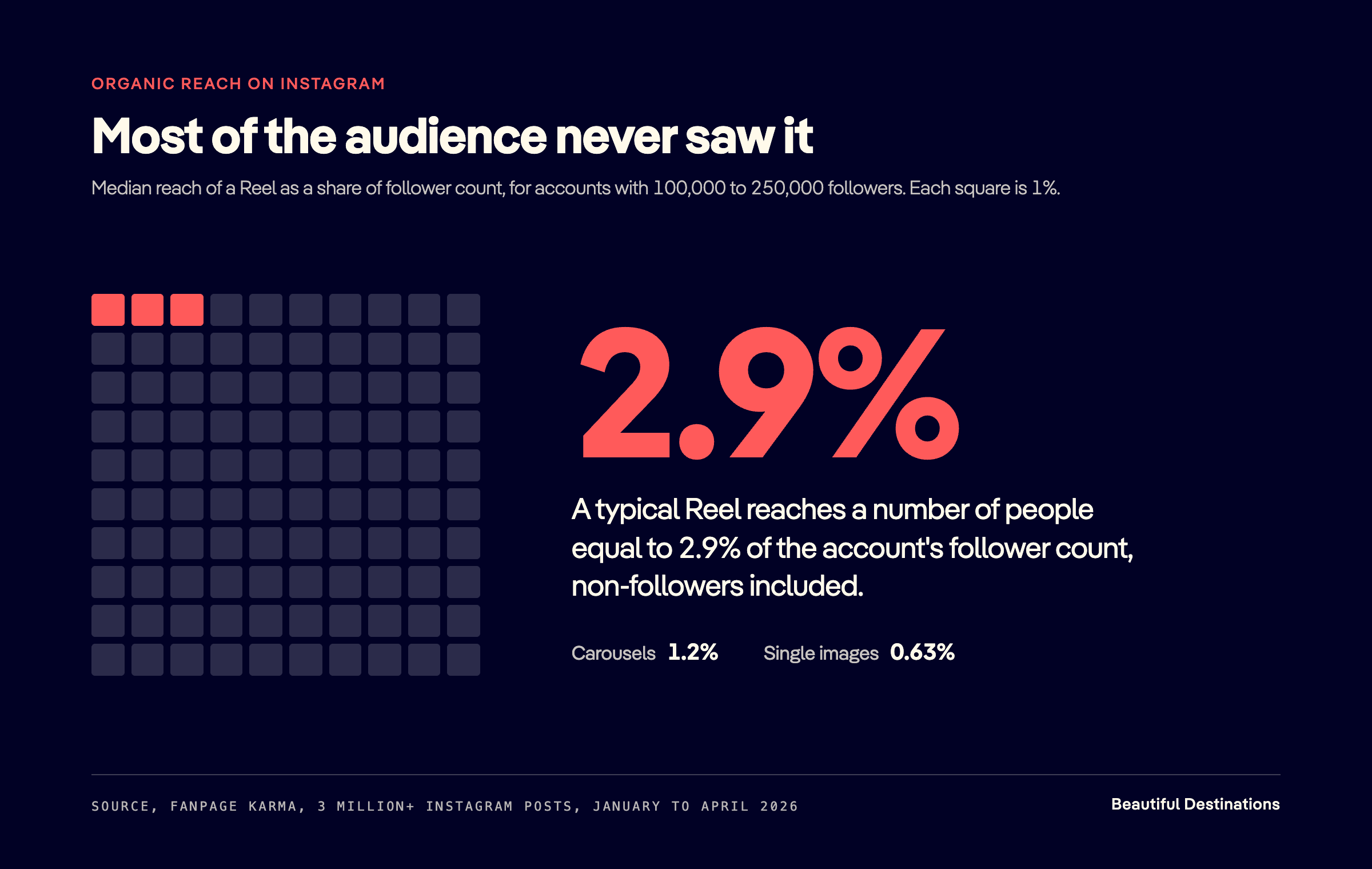
The common worry is that people tire of seeing the same thing. Mosseri himself has said that a lot of an account’s followers won’t open the app on a given day, and those who do have more posts to see than time to see them. A 2026 analysis of more than 3 million Instagram posts found that for accounts with 100,000 to 250,000 followers, a typical Reel reaches a number of people equal to 2.9% of its follower count, non-followers included. Months later, most of the audience never saw the original. No brand would run a billboard once and take it down because the people who drove past on Tuesday might see it again on Thursday.
Stop measuring content by its first appearance
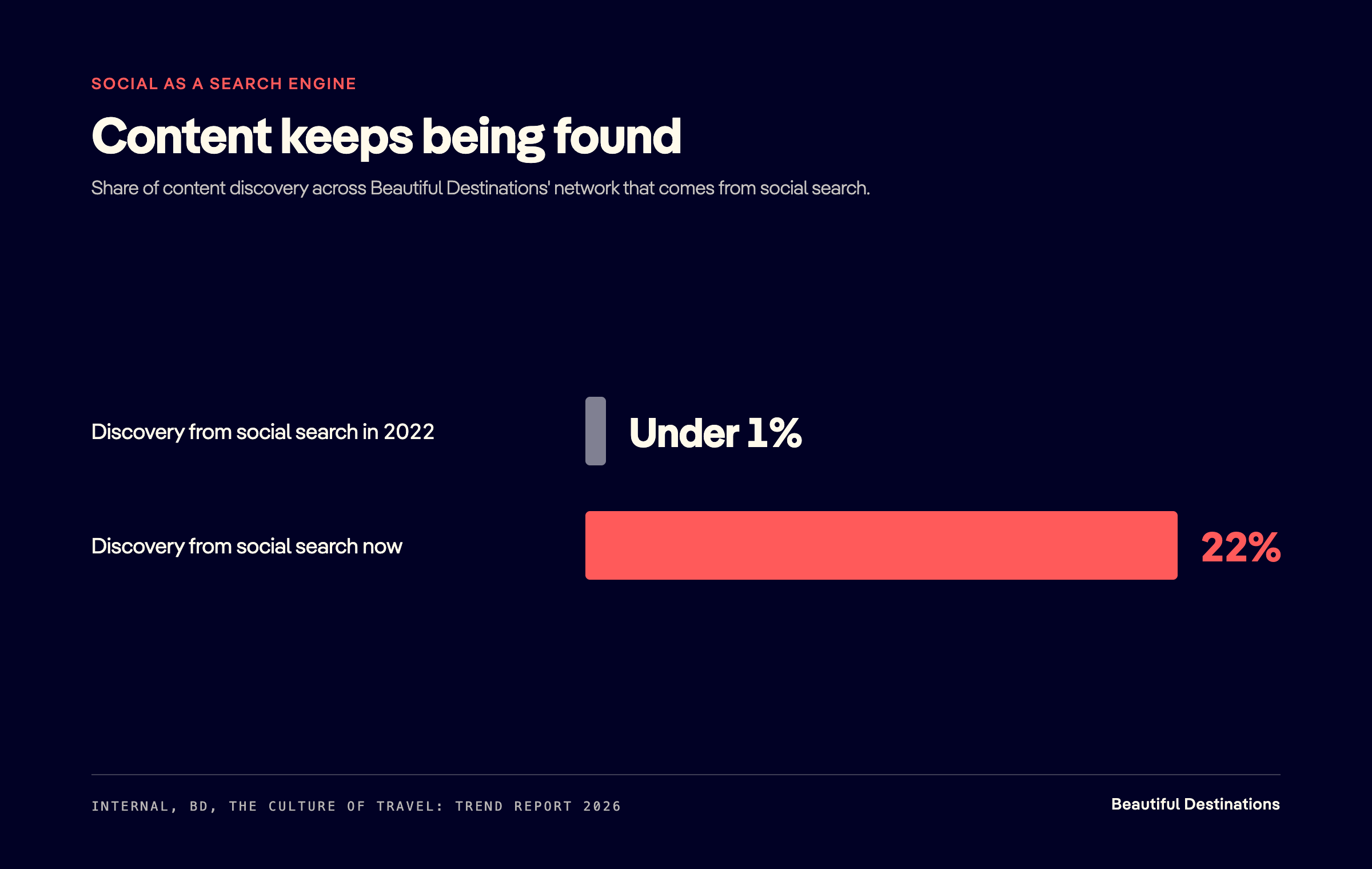
On social, the same experience from a shoot can do several jobs. A sunrise hike can be a Reel that makes people want to go, an itinerary showing how to fit it into a three-day trip, and a guide carousel with the route, the timings and what to bring, designed to be saved. Those pieces keep being found, too. Across BD’s network, 22% of content discovery now comes from social search, up from under 1% in 2022, so content keeps working long after the day it went up.
The same production also works beyond the feed. A hero film becomes an itinerary page, a hotel guide, trade material, an email, paid creative aimed at a different audience. Interviews become articles. Practical footage can be recut to answer the questions travelers put into search engines and AI assistants, and recut again as those questions change.
Travel brands need more content than ever. Shooting more often is part of that. Working each shoot harder is the part nobody is doing.
That requires a change in how production is briefed, how calendars are built and how performance is measured. Done well, the result is a system that publishes proactively, meets travelers’ needs and responds to changes in trends and demand.
Sources
Beautiful Destinations, The Culture of Travel Report, 2026
Expedia Group, The Path to Purchase: Uncovering How Travelers Plan and Book Online, 2023
McKinsey / Skift Research, Winning Hearts in an Age of Infinite Travel Choices, 2026
Fanpage Karma, Reel, Carousel, or Image Post: Which Format Delivers the Most Reach at Each Account Size?, 2026
Adam Mosseri, Instagram Reel on Getting More From a Post That Worked, 2026
Adam Mosseri, Threads Post on Why Posts Don’t Reach Every Follower, 2024