

.png?width=903&height=508&name=Article%20Hero%20Images%20(7).png)
Finlay Millar | Senior Strategist | 29 September 2026
Abundance is the most common strategy in travel. More to do, something for everyone, too much to fit into one trip. It runs through travel brands' campaigns, slogans and social content, with top 10 listicles and packed itineraries a staple across travel feeds. It makes sense in theory. How do you persuade someone to travel to your destination? Show them there's an abundance of things to do, whatever they're into. Once you come here, you'll never need to go anywhere else.
While there is no doubt plenty of people arrive in a new destination aiming to do and see as much as possible in the time they have, the approach has led to real uniformity in travel marketing. Destinations show off their contrasts (the beach and the city!), their countless restaurants and bars, and all their iconic landmarks alongside the live-like-a-local spots you have to tick off before you leave. What's rarer is destinations focusing on the other side of this: showing a place that asks little of the people visiting.
Space to do what you came for
The idea of a vacation that gets you away from the crowds and the stress of everyday life is hardly new. It's been mentioned in almost every trend report since the first one was written with a quill. The common misconception is that people want nothingness so they can do nothing. For a lot of travelers, that isn't the draw. Some will want to sit with their feet up staring into space, but I'd argue what they're really seeking from these trips is permission to do whatever they want.
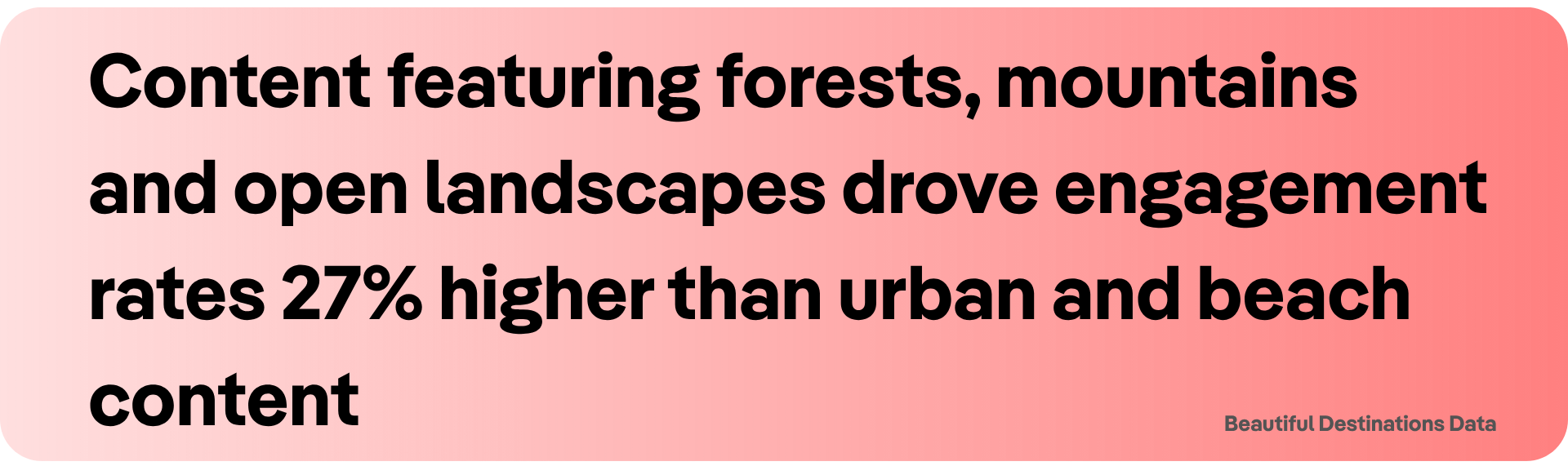
This kind of trip is showing up across this year's trend reports. Hiking, reading and other hobbies are gaining momentum. Booking.com found 74% of travelers would consider fishing or birdwatching when traveling, while Vrbo saw Pinterest searches for "book club retreat ideas" rise 265% and reading-related terms in its guest reviews nearly triple. Within our own content, we found that content featuring forests, mountains and open landscapes drove engagement rates 27% higher than urban and beach content. Audiences are drawn to open, natural settings that offer escape and calm. But escape doesn't always equal traditional relaxation.
The real escape is obligation
I believe what's really being escaped is obligation. People travel to get away from everyday life, with all its responsibilities and to-do lists. A destination strategy built on abundance and 100 must-see activities puts almost the same burden back on them. Come back from Paris, New York or Rome without seeing everything you were supposed to, and there's a level of guilt.
That's why I'm not surprised that on BD channels, content from destinations like Kazakhstan, Sweden and Iceland is consistently outperforming more traditional favorites like France and Italy, with higher save rates (signaling stronger planning intent). Montenegro saves at 3.2x the median across BD Instagram content, and posts about lesser-known destinations on BD TikTok get 2.5x the average save rate. Being unknown is certainly part of it, but I'd argue the bigger draw of these destinations is permission to do exactly what you want and make the trip your own.
Every destination has a quiet side
This permission is not exclusive to lesser known spots. Every destination has places that offer it, even the traditional favourites. But on social, those places are drowned out by the classic hotspots, and in wider strategies they're sold as one more thing to tick off.

When a destination does commit to going against abundance, it can pay off. In 2018, Nebraska challenged the traditional “something for everyone” thinking with the slogan "Honestly, it's not for everyone." One ad read "Lucky for you, there's nothing to do here," shown over people floating down a river in a livestock tank. Others showed a couple hiking rugged terrain, or children playing by a waterfall. The commission reported that likelihood to visit rose from about 17% to 39% after the campaign launched. And the ads themselves showed what nothingness really means: permission to spend your trip doing exactly what you want, guilt-free.
Permission is the pitch
This isn't to say that abundance is always the wrong strategy. It's just not automatically right. Many people travel with this mindset, and for some destinations, it's genuinely what makes them stand out in their region. However, if you look around at your competitors and every one of them is communicating the same message, then even if there's a lot to do, abundance is not the way to stand out. The more crowded the checklist gets, the more it's worth being the destination that doesn't hand one out.
Sources
Beautiful Destinations, The Culture of Travel Report, 2026
Booking.com 2026 Travel Predictions
Unpack '26, VRBO / Expedia